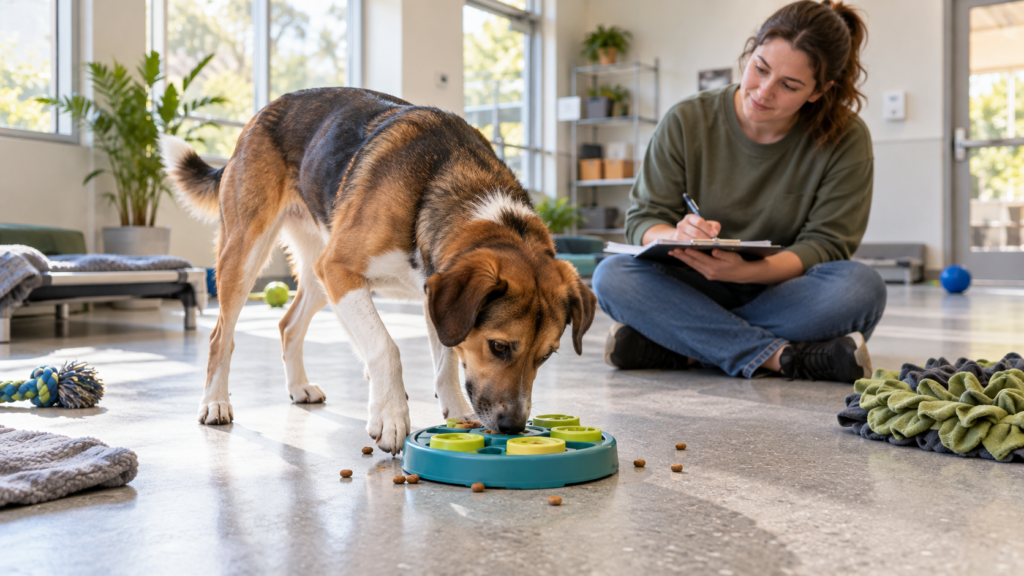
Animal enrichment means creating safe, species-appropriate opportunities for animals to choose, explore, forage, move, think and interact. Good enrichment is not simply giving an animal a toy: it starts with the individual animal’s needs, has a welfare goal, is introduced safely and is reviewed through observation.
Whether you care for animals at home, in a shelter, boarding facility or supervised workplace, the central question is not “Is this activity fun for people to watch?” It is “Does this give this animal a meaningful opportunity to express important behaviour without creating avoidable risk?”
Environmental enrichment modifies an animal’s surroundings or routine to support positive experiences and relevant behaviour. The RSPCA Knowledgebase describes enrichment as physical and social opportunities that promote behaviour important and specific to the animal. It emphasises choice, control and problem-solving—not just toys.
Enrichment should complement, never replace, essentials such as suitable housing, nutrition, exercise, veterinary care, rest, hygiene and humane handling. A stressed or unwell animal may need a health or environmental problem addressed before more stimulation is added.
| Type | Welfare purpose | Possible examples |
|---|---|---|
| Food and foraging | Encourages searching and problem-solving | Scatter feeding, puzzle feeders, hidden approved food |
| Physical | Supports movement and use of space | Platforms, climbing routes, digging areas, varied substrates |
| Sensory | Offers controlled smells, sounds, textures or visual interest | Scent trails, safe natural materials, viewing areas |
| Cognitive or occupational | Creates achievable mental challenges | Choice-based training, manipulation tasks, novel objects |
| Social | Supports appropriate interaction or companionship | Compatible conspecific contact, calm human interaction |
These categories overlap. A scatter-feed activity can involve food, scent, movement and problem-solving. The label matters less than the outcome for the individual animal.
Research what the species is motivated to do: sniff, forage, climb, perch, dig, hide, chew, bathe, explore or seek social contact. Use reputable welfare and veterinary sources. Avoid assuming that an activity suitable for dogs is safe for cats, rabbits, birds or rodents.
Consider age, health, mobility, history, confidence, diet, social preferences and current environment. An older dog with joint discomfort, a fearful new shelter arrival and an energetic adolescent need different plans. Seek veterinary or qualified behavioural guidance when health, pain or serious behaviour concerns are involved.
“Provide enrichment” is too vague. A useful goal could be to encourage more voluntary sniffing, give a cat another resting choice, extend safe foraging time or reduce long inactive periods. A clear goal helps you decide whether the activity works.
Inspect materials for choking, entanglement, toxicity, sharp edges and ingestion risks. Check dietary restrictions and total food allowance. Consider resource guarding, escape risks and whether direct supervision is required. Workplace policies and the animal’s care plan take precedence over online ideas.
Allow the animal to approach and disengage where possible. Novelty is not automatically positive; it may be frightening. Begin at an easy level, avoid forcing contact and ensure the animal can retreat to a safe resting space.
Record what was offered, duration, relevant behaviour and any safety issue. Look for relaxed engagement, voluntary re-engagement and normal recovery afterwards. Stop if you see escalating fear, frustration, conflict, compulsive behaviour or physical risk.
Increase difficulty only when the animal is succeeding. Rotation can preserve interest, but constant novelty may be stressful. Keep familiar preferred options available and change one variable at a time so the response is easier to interpret.
These are starting points, not universal prescriptions. Confirm suitability for the species and individual. The RSPCA’s enrichment guidance for rats, for example, stresses that activities must fit normal behaviour, physical attributes and the existing environment.
| Possible positive signs | Reasons to pause and reassess |
|---|---|
| Voluntary approach and investigation | Avoidance, freezing or repeated escape attempts |
| Relaxed, species-relevant behaviour | Escalating frustration or frantic behaviour |
| Ability to disengage and rest | Fixation that prevents normal rest or feeding |
| Repeated engagement without conflict | Guarding, aggression or competition |
| Safe use of the item or space | Chewing, swallowing, trapping or entanglement risk |
Behaviour must be interpreted in context. A wagging tail, purr or vocalisation alone does not prove a positive emotional state. Look at the whole animal, the situation and change over time.
Careful enrichment planning depends on observation, welfare knowledge and clear role boundaries. Careers Collectiv is a private online college. The Certificate in Animal Welfare is 100% online, with three modules and approximately 200 study hours covering animal healthcare, animal welfare theory and wildlife conservation. Check the live course page for current inclusions and terms. A private course does not replace workplace induction, veterinary advice or any regulated qualification required for a particular job.
For related career context, read what an animal welfare course teaches and our guide to building animal care experience.
Its purpose is to support positive welfare by giving an animal safe opportunities to express important behaviour, make choices and engage with its environment.
No. Toys can be one tool, but enrichment also includes foraging, space use, sensory opportunities, training and appropriate social interaction.
There is no universal schedule. Review the animal’s response and balance useful novelty with familiar, preferred options. More change is not always better.
Yes. It can affect calorie intake, trigger guarding or be unsuitable for a medical diet. Use approved food, account for the daily ration and separate animals when needed.
Do not force interaction. Reassess the timing, difficulty, sensory qualities and whether the activity is relevant to that individual. The animal may prefer another option or need rest.
It may form part of a broader plan, but it is not a diagnosis or stand-alone treatment. Consult a veterinarian or appropriately qualified behaviour professional for concerning or sudden behaviour changes.
In workplaces, follow organisational policy. Brief records can help a team monitor preferences, engagement and risks, while protecting client and organisational confidentiality.