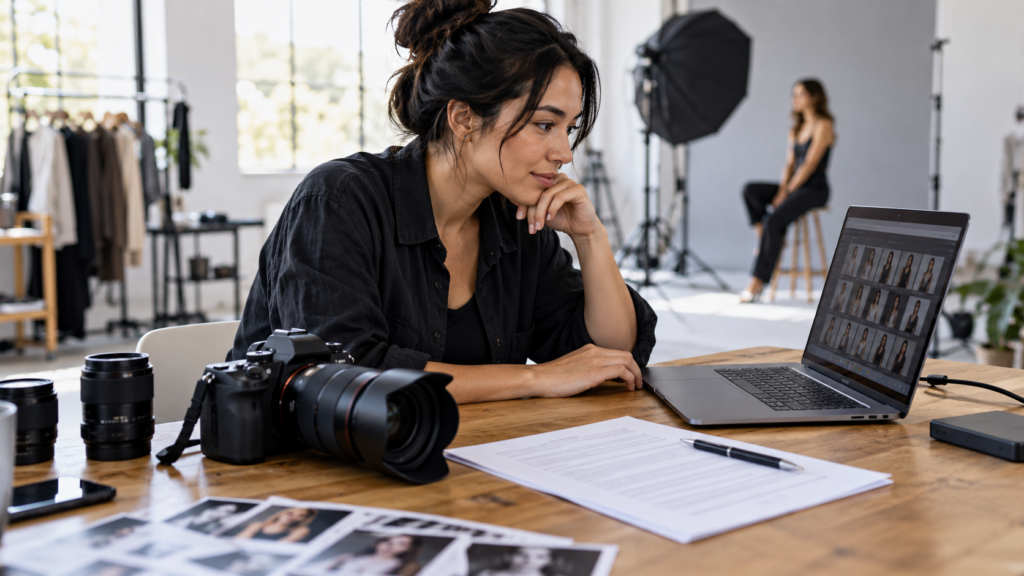
Photography copyright Australia guidance starts with a simple rule: copyright generally arises automatically when an original photograph is created, but the photographer is not always the copyright owner. Employment, commissioning arrangements, contracts and assignments can change ownership or permitted use, so photographers should confirm the terms before a shoot and document every licence in writing.
This beginner’s guide explains practical concepts for photographers, clients and small creative businesses. It is general information, not legal advice. Copyright disputes and unusual commercial arrangements should be reviewed by a lawyer or the Australian Copyright Council.
Photography copyright Australia rules protect particular original expression, including photographs. Unlike a trade mark, patent or registered design, Australian copyright does not use a government registration system. The Australian Copyright Council’s photographers and copyright information notes that Australia has no copyright register.
Copyright is separate from owning a camera, memory card, print or digital file. A client can own a framed print without owning the copyright. Similarly, delivering high-resolution files does not automatically transfer every right unless the agreement says so.
| Issue | Main question | Practical response |
|---|---|---|
| Copyright | Who owns and may reproduce or communicate the image? | Confirm ownership, assignment and licence terms. |
| Model permission | What uses has the person agreed to? | Use an appropriate written release and explain intended uses. |
| Privacy | Is personal information being handled lawfully? | Consider applicable privacy obligations and secure storage. |
| Location or property rules | Was photography permitted at that venue? | Check access terms, permits and commercial-shoot policies. |
| Trade marks | Could branding create confusion or require clearance? | Review commercial context and obtain advice where needed. |
Having copyright does not answer every question about publishing a photograph. A robust workflow considers all relevant rights and expectations.
Ownership depends on the circumstances and current law. The creator is often the starting point, but employment and certain commissioned photographs can be treated differently, and a written agreement can assign copyright. Do not rely on a social-media comment or handshake for a valuable commercial shoot.
| Scenario | Question to check | Best practice |
|---|---|---|
| Independent portrait photographer | Do commissioning rules or the contract alter ownership? | State ownership and permitted client uses in the booking terms. |
| Employee taking photographs | Were the images created in the course of employment? | Review the employment agreement and obtain legal advice if unclear. |
| Freelancer for a business | Is the client receiving a licence or an assignment? | Define media, territory, duration and exclusivity. |
| Second shooter or collaborator | Who created each image and what was agreed? | Use a written contractor or collaboration agreement. |
| Client supplies images | Does the client have authority to provide them? | Require confirmation of rights and keep a source record. |
An assignment transfers copyright ownership. A licence permits specified uses while ownership can remain elsewhere. These are materially different commercial outcomes.
A useful licence answers practical questions before publication:
Plain language is valuable, but clarity does not mean guessing at legal effect. For higher-value campaigns, unusual ownership requests or international use, obtain professional advice.
No. Uploading a photograph to a website or social platform does not, by itself, place it in the public domain. However, the platform’s terms may grant it a licence to host, display or process the content. Read current terms before uploading valuable work and do not assume that a watermark prevents copying.
Likewise, finding an image through a search engine does not give permission to reuse it. IP Australia’s copyright guidance explains that third-party photographs may require permission before reuse. Use properly licensed sources and retain evidence of the licence.
Put pricing, cancellation, deliverables, ownership, licence scope, portfolio use and release expectations in writing. Give the client time to ask questions. For consumer clients, ensure terms are fair, transparent and consistent with Australian Consumer Law.
Retain original files, capture dates, selection records, invoices, signed agreements and delivery correspondence. Use consistent job identifiers and backups. Metadata can support workflow and attribution, but it is not a substitute for a contract.
For commercial work, distinguish the labour of creating images from the value of using them. A local organic social post and a nationwide paid advertising campaign are not equivalent uses. Pricing models vary, but the permitted use should be explicit.
A model release documents permission for specified uses of a person’s likeness; it is not the same as a copyright assignment. Extra care is required with children and vulnerable people. Explain how and where photographs may appear rather than using a vague form nobody understands.
Provide the file sizes and formats required for the licensed purpose. Tell clients whether they may apply filters, remove attribution, give files to third parties or submit them to publications. Do not bury important restrictions.
Photographers often want to show commissioned work in a portfolio, but clients may expect confidentiality. Address portfolio and awards use before the shoot, especially for private events, product launches and sensitive organisations.
Do not send an automatically generated demand simply because two images look similar. Confirm authorship, rights, exceptions and the actual use first.
Technical skill matters, but a sustainable photography practice also needs clear client communication, careful file handling and a working understanding of usage. Careers Collectiv is a private online college. Its Professional Photography Certificate is 100% online, with five modules and approximately 300 study hours. It develops technical and artistic foundations across areas such as portrait, wedding and brand or product photography. Check the live page for current curriculum, equipment inclusions, fees and terms.
Continue with our guides to starting a photography business in Australia and pricing photography packages.
No government copyright registration system exists in Australia. Protection generally arises automatically, although records remain important when proving creation and rights.
Not necessarily. Ownership depends on the legal context and agreement. The client may receive a licence, an assignment or rights affected by specific commissioning rules.
Only after checking the contract, release, confidentiality obligations and client expectations. Agree on portfolio use before the shoot whenever possible.
Credit does not automatically provide permission. Platform features and terms can affect sharing, but downloading and republishing may require a licence.
Copyright concerns rights in the photograph. A model release records permission connected with the depicted person and particular uses. One does not automatically replace the other.
That depends on the licence or agreement. State clearly whether crops, filters, retouching, text overlays or derivative versions are permitted.
Duration depends on factors such as when and how the work was created or published. Because transitional rules can be complex, check the Australian Copyright Council’s current duration guidance rather than relying on a single rule of thumb.
No. It provides general educational information. Seek professional advice for ownership disputes, substantial licensing deals or unusual facts.